
Roads to Resilience


_Corps_pen.png)





.png)


Riga 2025
Common Effort’s conference ‘Roads to Resilience’ brought together civilian and military partners from across the globe to strengthen cooperation on resilience, crisis response, and hybrid-threat preparedness. Hosted in Riga, at the heart of NATO’s eastern flank, the conference underlined the importance of early coordination and trusted relationships in today’s complex security environment. Although the annual conference of Common Effort has come to an end it is the beginning of new partnerships.
3 Days
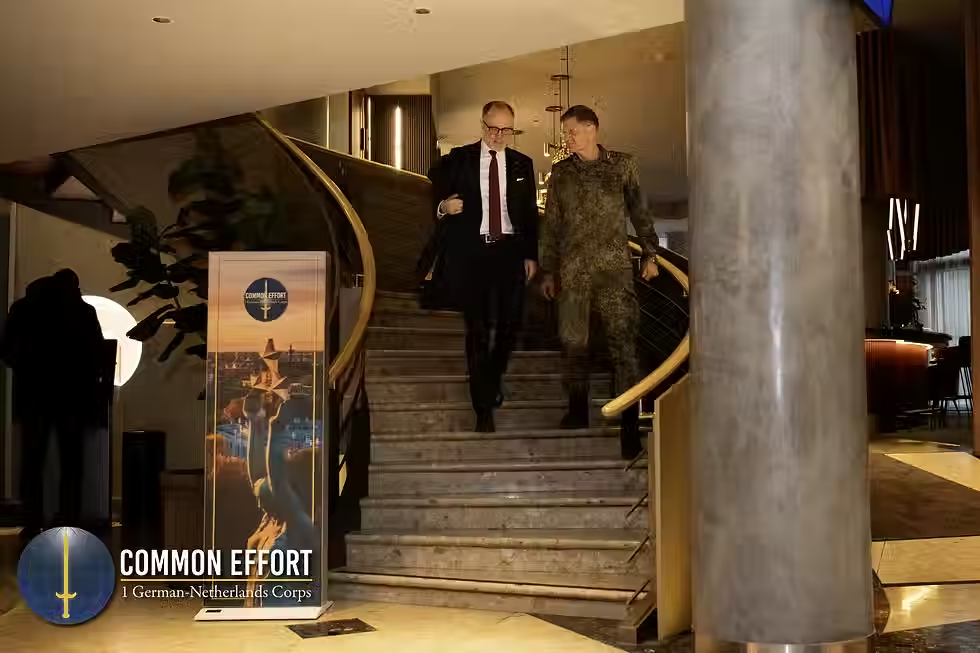


Over three days, participants engaged in focused working groups, keynote speeches, expert panels and a scenario-based training simulating the preparation phases in advance to hybrid conflict escalation. The event highlighted how governments, emergency services, private industry, academia, and the armed forces depend on each other to safeguard continuity of society and support military operations.


Day 1
Opening & Networking
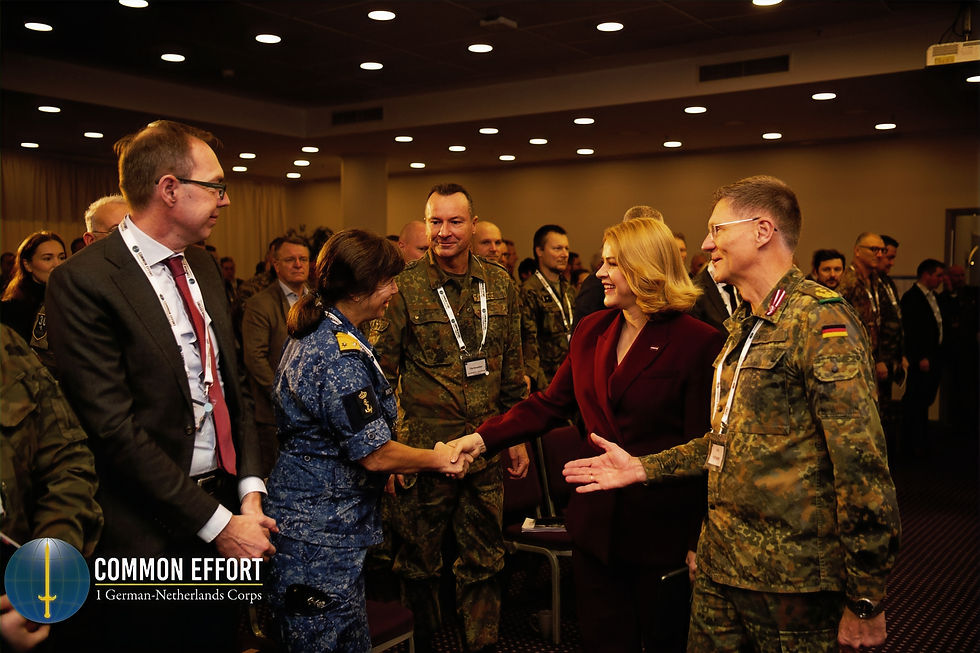
The conference opened with welcome remarks from 1GNC Commander Lieutenant General Peter Mirow and the Riga’s Mayor Viesturs Kleinbergs, followed by an informal networking session. Participants had the opportunity to build initial connections essential for effective cooperation to prevent crises, to prepare for crises and during crises.

Day 2


Hybrid warfare, Crisis Response & Multi Domain Operations, Civil Preparedness & Scenario Based Training
Day 2 featured an opening speech by the Latvian Prime Minister Evika Siliņa, a keynote by Professor Gunhild Hoogensen Gjørv and three parallel working groups on hybrid warfare, crisis response & multi domain operations, and civil preparedness.
Besides the working groups, the scenario-based training, where both civilian and military participants jointly responded to a simulated hybrid escalation in the Baltic region, reinforcing the value of timely communication and shared situational awareness.


Day 3

Preparedness Panels & Closing
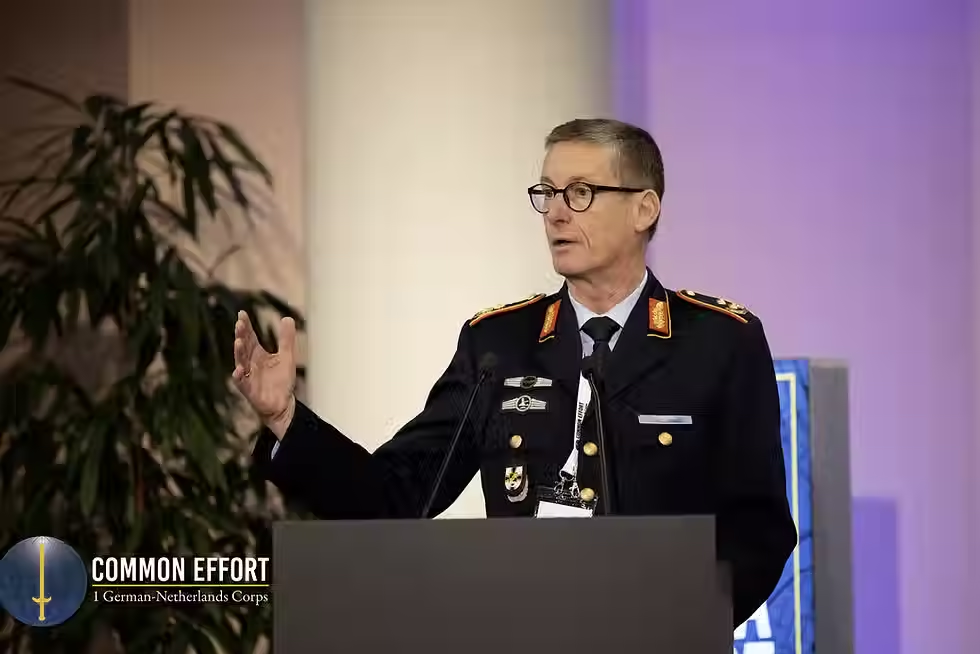
The final day brought strategic discussions in three panels: military preparedness, civil preparedness, and infrastructure resilience. Speakers highlighted the increasing need for whole-of-society readiness, robust critical infrastructure, and strong civil-military partnerships. The conference closed with reflections by Lieutenant General Mirow and our conference moderator Eddie Corrigan.


Key Takeaways
Proactive control mechanisms and mutual decision-making within established legal frameworks further reduce vulnerabilities, creating more resilient partnerships.
Finally, civil-military collaboration benefits from UNCLAS scenario-based exercises, functioning as stepping stones towards NATO exercises, enhancing collaboration competencies in civil-military partnerships across all operational levels.
The task now is to implement these insights in line with our guiding principle:
"Together Strong."
3/3
Key Takeaways
Preparedness starts long before a crisis. Scenario-based training and cross-sector dialogue build the trust, procedures, and common understanding needed during real-world events.
The Baltic region is central to European resilience. Riga’s strategic location underscores the importance of regional cooperation, deterrence, and shared responsibility for security.
Understanding and navigating in local security contexts play a critical role in shaping the specific needs and methods of civil-military collaboration, ensuring that responses are tailored to the unique circumstances.
2/3
Key takeaways
Resilience requires whole-of-society approaches; Governments, emergency services, businesses, and the military benefit from mutual preparation to maintain essential functions during crises.
Hybrid threats demand early coordination. Cyberattacks, disinformation, and influence operations increasingly blur the boundary between peace and conflict, requiring rapid information-sharing and integrated responses.
Strong civil-military partnerships are essential for crisis response. Continuity of energy, transport, communication, and healthcare systems directly affects NATO’s ability to operate effectively.
1/3


Team Members
Maj Huib Zijderveld
OPR (Event Director)

Lt Henry Draaijer
Deputy OPR (Event Manager)

Maj Andres Adelaar
Chief VIP Relations

Lt Olivier Pruymboom
Chief Communications

Cpl Ruiz Lagadeau
Chief Branding & Design

Johanna Patz
Intern, communication
